Yes, yes, yes the city is growing quickly, something new every day, blah, blah, blah.
But sometimes, all the chatterers have a point.

Showing posts with label Dubai. Show all posts
Showing posts with label Dubai. Show all posts
Thursday, May 15, 2008
Standard Dubai Photo of the Day

Tuesday, May 13, 2008
Dubai as Metropolis
 Everyone likes to compare Dubai to SimCity (plant some residences here, throw down a few business areas there, all close to instantly), and hail the creation of a shining city from the desert in a relatively short time. I see their point. I write this in just such a shining tower in an area that was empty air and hot sand less than 10 years ago. But I still maintain that the more apt comparison is Metropolis in Fritz Lang's classic film of the same name. I enjoy the views, the ocean, the nice cars, (almost) tax-free income and generally not having to lift a finger for anything, knowing that someone, somewhere is taking care of it. But I also know that there is another side, and life for the underclass is very different. The work camps might as well be in a different country as my Marina-based existence. They aren't a secret, as in Metropolis, but they are invisible (at least one sprawling workers' area doesn't appear on any maps), and they definitely live different lives.
My view while eating dinner tonight
(click for larger version)
(click for larger version)

Work area outside of Dubai taken the same day
(click for larger version)
(click for larger version)
Sunday, May 11, 2008
Perhaps not only in Dubai
but not in very many other places.
I am flying on four trips between New York, Sydney and Dubai over the next few weeks. Business class is full in three of them, but economy is mostly empty. This is not the first time that business class sold out before economy, which is very aggravating as I am not always able to plan my exact travel dates way in advance. But still interesting, as there are not many places where business class sells out before economy.
Wednesday, April 30, 2008
Another review of the Palm
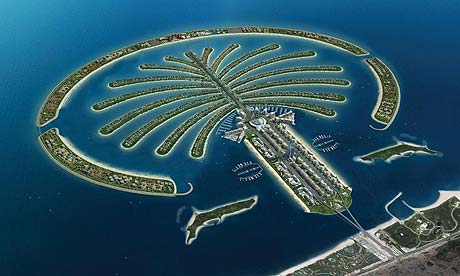
One of the things people in other countries often ask one about Dubai is the Palm. Not all know that there is more than one, but the concept is certainly famous enough that people are curious. While parts of it are nice, there are less-appealing aspects, including the questionable environmental impact and less than fully reliable real estate arrangements. Add rumors of sinking sections causing damage, the fact that even palm Jumeirah is still a construction site (we rented a place out there a few months ago when some of my elephant polo team met up in town en route to a tournament, and our apartment door was labeled"occupied" to distinguish it from all the rest. I went swimming with the dear sister, and felt more than a little guilty swimming under the gaze of the near-by construction workers. The trunk road is also a pain; in order to minimize traffic, it is all one-way. If your place is on the left side of the trunk as you enter, you must drive down it to turn around to et to your building. This gets old. Even the larger, more expensive villas are pretty close to one another as well, making privacy difficult), my own concerns about traffic (the trunk connects to the road at one point, one future serious traffic choke point), rumors of sharks out near the end fronds (there are sharks in the Gulf, but far out. But the Palm is far out) and the general kitchiness question.
Now the mainstream press, often so positive (with the exception of some articles devoted to the plight of laborers and domestics) is starting to notice as well. The Guardian ran an article titled "Pitfalls in Paradise: Why Palm Jumeirah is Struggling to Live Up to the Hype," first brought to my attention by Grape Shisha.
To be fair, only roughly 4,000 people of the 65,000 who will eventually live there (plus the 40-odd hotels) have already moved in, so you can't say that the Jumeirah Palm is "done," so some of these issues may be fixed in the future. But some may also be exacerbated.
Among the issues detailed by the Guardian:
- Multimillion-pound villas squeezed together "like Coronation Street" (a British soap opera including a street of that name, full of tight houses). This is also apparently the result of deceptive construction practices ala the metro line. The article quotes Rachael Wilds, 42, an exhibition organiser from Surrey who moved in with her family to a palatial villa on one of the Palm's "fronds" a year ago, who complained that she found her £3m property squashed against a neighbour's and set in a barren, almost treeless, landscape. "It was absolutely nothing as it was depicted in the brochure," she says. "There was a massive gap between the villas and it was full of lush tropical gardens. We were totally shocked at the closeness of the villas." What is true elsewhere is doubly true in Dubai. Caveat Emptor.
- Air-conditioning bills of £800 a month (roughly 1600 USD). This is just poor engineering. Its not like the weather would be a surprise. Could they not make the houses more efficient? This is also the buyers' fault too though - they should have paid attention to such things.
- Overly-pushy PR. The villas were built by state-owned Nakheel Properties, and their is omnipresent on flags all over the island. For some residents, this is a little much. Again to be fair though, flags with logos and slogans are all over Dubai, especially along bridges and main roads. So complaining that the Palm is doing this may also fall under the "well, what did you expect" rubric.
- Intensive irrigation is necessary to maintain the landscaping, but uses tremendous amounts of water (note: most of the water will come from desalinization plants, which themselves use tremendous amounts of energy)
- Tallest trees actually mobile phone masts dressed up to look like palms (I didn't notice these, so they must be at least OK. There is one across from the entrance to Madinat though and it isn't bad for what it is)
- Guilt over the quality of life of the migrant construction workers. This is a real concern. But again, this is a pan-Dubai issue and one people should consider when purchasing anywhere here. Problems mentioned in the Guardian include low salaries of 200 USD per month, debts to agents in their home countries who paid for their passage with interest rates as high as 120% a year, increasing alcoholism and debts accumulated to pay for said drink, unpaid salaries, poor living conditions, rising suicide rates and separation from families at home.
Some numbers from the Guardian:
13m: The number of liters of desalinated drinking water the Palm Jumeirah uses when at capacity (they didn't say in what period. It may in one day).
28: Bottlenose dolphins have been flown in from the Solomon Islands to populate Dolphin Bay, an 11-acre lagoon
94m: The cubic meters of sand used to build the Palm Jumeirah
84: The site has doubled the natural 42-mile coastline of Dubai
4: The Palm is four times the size of Hyde Park in central London
More Taxis Please. And Possibly a Traffic Policy.
It used to be that getting a cab in Dubai wasn't that difficult. They were usually just "around." then more and more people came, the numbers of taxis did not increase
The other day I was unlucky to find myself in need of a taxi in Deira on a Friday night around 530pm. It took 45 minutes (I even saw several empty, on-duty cabs that I know saw me, but chose to drive empty to another location rather than pick me up in Deira). When I finally did get a taxi, I was almost beat out by a trio of men who were slightly faster, and the cab only gave me a ride faster much begging for him to chose me as I had been waiting so long and really had to leave. Prior to getting that cab, I tried getting one at a near-by hotel, but they told me that they had two groups of guests waiting for cabs they called over 30 minutes ago, and that I would have to wait for them first.
The driver that ultimately did pick me up was really, really nice. In fact, the nicest taxi driver that I've ever had in Dubai, and possibly the nicest I've ever had, ever. There are a couple others that also qualify, but still he went above and beyond in a few ways and I was very impressed.
Anyway, said driver said that the reason I couldn't get a cab in Deira is that drivers don't like to go there, and avoid it whenever possible. This is because traffic is so bad they don't make any money - they would rather take fares in other parts of the city where they cover kilometers quickly.
Which brings me to my Question of the Day: Why can't they just add a fair amount to the "waiting in traffic timer" to the meter? Then drivers would be paid for their time, and therefore more willing to pick people up. Passengers might complain, but they would at least get service, which is more important to me, anyway, and really, if they are spending time in traffic driving a customer around, then that time is part of the service, and passengers should pay.
The real problem of course is traffic, but solving that requires massive infrastructure programs and thoughtful long-term urban planning. In the mean time I would just be happy if I could get a cab in which to sit in said traffic.
Update: I took a taxi today where the driver, very newly arrived from Pakistan, did not know where the Marina is (the large neighborhood, not one of the actual places for docking boats). Fortunately I knew, but he clearly couldn't read English (he thought the Westin hotel's sign said Ritz Carlton, and he pronounced the latter Ride Car), and had difficulty understanding my directions, initially setting out towards Jebal Ali (another, far area in the wrong direction). Now of course, given the reliance on foreign labor to fill such positions, there will be drivers new to the city. But a basic course in the geography of the city should be required, and (as this I already technically required), enforced. I'm sure its cheaper and easier to just send the new drivers out and let them learn while the meter is running, but it isn't very helpful to the passengers. I at least knew where I was going. Dubai's many tourists will not, and will end up lost, frustrated and overcharged.
Monday, April 28, 2008
High Divorce Rate Among Nationals Due to Second Wives
I just saw this older article discussing the high divorce rate among Emirati men. Apparently 31.9 % of all divorces among UAE Nationals are due to the men taking a second wife. According to a study published by the Ministry of Labor and Social Affairs magazine, 28% of all marriages registered by Emirati men are to foreign women, and most of these are second marriages.
I'm not sure what the cause of this "second foreign wife" phenomenon is, but a few years ago I heard a story about a phenomenon amongst the Taliban, whereby the already-married Talibs arrived in Kabul (sans village wife) and married again to a more sophisticated and exciting city wife. These cases could be the same; "first I married, the socially-acceptable choice, now I marry the one I really like/hot on." Or it could be a case of expenses; marrying within the community costs tens of thousands, if not hundreds of thousands, of dirhams, something that a man may not want to do twice. Or it may simply be the lack of good local options for a second wife; clearly bigamy is upsetting to the first wives; perhaps unmarried women also find it upsetting, and chose not to marry already-married men (original story here).
Alternatively, if a man would marry again over what are clearly his wife's strenuous objections, then maybe she just doesn't want to be with a man who could do something that upsetting to her.
Anyway, it's an interesting statistic.
PS In case you were wondering, 23.7% of divorces stemmed from financial problems, 34.4% childlessness (trying again with a different spouse. are there no fertility doctors to work out what is going on? Or are these divorces the result of people who have been, and are are seeking a spouse without confirmed fertility problems?), while 21.4% were the result of parental intervention.
Tuesday, April 22, 2008
The Hype is Moving West-ward
A few years ago, it was not uncommon to see ads for Dubai real estate in the US, specifically the DC and New York newspapers (those being the two US cities in which I spend the most time). There were even quasi-fraudulent "get rich investing in Dubai real estate" weekend seminars held in hotel ballrooms. Now that the market has stabilized (and may even go down a bit as more buildings are finally completed and go online, the marketing fury has moved on. I initially assumed it had just died down a bit to more rational levels, but my recent extended stay in Moscow suggests otherwise. There, ads for Dubai real estate about, with even flashing neon billboards and banners hanging from high rises touting apartments (sometime it is villas, but mostly apartments) here in DXB.
The advertising has even gone a step further. I am currently considering purchasing an apartment in Moscow (I would have done so already, but spending 1,300,000 Euros for a one bedroom, even a nice one, seems a bit much, and there isn't a lot of real estate that isn't either over budget or poor quality, which means I'm still looking), and I am starting to get annoyed by the number of listings, officially in Moscow, that are really for units in Dubai. I guess the idea is that anyone with money to buy real estate in Moscow could be tempted to spend instead in Dubai. The tactic must work, as these listings are everywhere, enough so that real Moscow sellers stopped using them and I've basically given up on independent listings and am sticking to Moscow real estate agencies and their own vetted listings. It's a real pain though - Moscow agencies don't usually cross list, which means that I have to work with several agencies to see a good range of places.
Sunday, April 20, 2008
Ships Impounded for Middle East Internet Cable Cuts
Although Egyptian authorities said that satellite imagery showed no activity around the cable that was damaged off of their coast, Dubai disagrees.
It looks like last week Dubai authorities impounded two ships who were spotted in satellite photos near the damaged cables around the time that they were cut. The ships were identified by Reliance Globalcom, whose FLAG Telecom unit maintains the cables, and which in turn notified the Dubai Port Authority.
Officially, the two ships, the MV Hounslow and MT Ann improperly dropped anchor near the cables and accidentally severed them. When they arrived in Dubai on February 19, the Iraqi and Korean ships were seized. Reportedly, the Korean ship paid 60,000 USD in compensation to FLAG Telecom for repair costs while the Iraqi ship is sitll being held.
Whether other ships accidentally cut the other three cables serving the Middle East and caused a loss of power to a sixth is yet ot be determined. ;).
Friday, April 18, 2008
I don't get (fully) the Burj (Al-Arab)
 The building is really quite special. It is attractive, distinctive, and has done much for Dubai's international profile. Tom Wright certainly earned his commission (attractive photos follow). However, the furniture is a bit overdone/tacky (even in flashy Dubai) and the food really isn't that great, especially for the price. Friends visited from out of town last weekend, and we had a better dinner at Buddha Bar than at Al-Mahara (although the aquarium is very cool. I really like fish and fully intend to install quite a serious installation if I ever stop traveling and moving round so often). At this point I think it gets a lot of mileage as a landmark, and I'll continue to take curious visitors form out of town there, but otherwise, I'm much happier looking at it from 360 (when that's open) than going inside.


Sunday, March 23, 2008
The Environmental Impact of All Those Islands
A gold star to the Economist for discussing something that has bothered me for a long time. While swimming at the (Jumeirah) Palm beach for the first and only time last November, I noticed a few troubling things. The first of course was the ongoing construction - we were swimming on the trunk's beach, while a few hundred meters down the trunk construction workers toiled away on a new building, which made me feel a bit guilty/unwilling to get out of the water to avoid being looked at (even if they were far away). The other was the amount of shells on the beach. Being still mostly a construction site, the Palm didn't have that many people on it, and we were one of a few to have used the beach. It was covered in shells, some really good ones (large, colorful, etc), but almost all broken. At first I was thrilled, as I like shells and marine life in general, but then I realized what was going on; these were all of the shells dug up and crushed as part of the process of building the island. The water was crystal clear, and we saw a few fish (the emptiness of the beach meant that they were quite willing to come up to the waters edge, darting away only when my shadow fell on them), so clearly someone is enjoying the new islands, but I was quite worried by the sheer numbers implied by so many broken shells.
I also wonder about the sustainability of the islands' marine life. If the islands' fronds and coves are to stay clear, dredging and cleaning operations will likely be necessary. If this is the case, then they will be forever disturbing the "new life" these formations are to support. Not to mention the role played by the many boats, jetskis, swimmers etc that are sure to come.
PS The World, Universe, Palms, etc aren't the only islands. Apparently the wife of Sheikh Mohammed has one (although I'm not sure which wife - Hind, the first wife, has her own, Princess Haya, his more public junior wife, or the rumored Moroccan middle wife, who may or may not exist, may or may not really be his wife and/or may or may not be the mother of some of his children), and someone else has been making a reverse-island, i.e. custom waterways. ECONOMIST
How green is The World?
Evaluating Dubai's island-reclamation project
ITS DEVELOPERS call the three hundred islands laid out in the shape of the world map just off Dubai’s coast the “most innovative real-estate development on Earth”. These new artificial islands, known as “The World”, are just part of a plan to create hundreds of kilometres of new waterfront for Dubai, attracting visitors and wealthy home-owners from around the (real) world.
The World’s developer, Nakheel, built its first artificial-island chain in Dubai in 2001 in the shape of a palm. By 2007, Palm Jumeirah, as it was called, claimed to be the world’s largest man-made island. Construction of two more giant islands, as well as other projects along the coast, are well underway. In January of this year, the last rock was put into The World's breakwater, which stretches for 27km and uses 34m tonnes of rock. Buyers have already started to move in.
AP
ds are built the same way. Masses of sand are gathered from the seafloor of the Arabian Gulf. The sand is then brought to Dubai and sprayed in a giant arc onto the shallow (10.5 meter) seabed off the coast. The sand piles up until it breaks through the surface of the water and forms an island about 4.5m high. Then a massive breakwater is built around the islands to protect them from the stiff local sea currents. It is expensive work: each development typically costs billions of dollars.
The short-term environmental consequences of this reclamation are clear: the intensive construction of Palm Jumeirah created vast plumes of sediment that turned blue seawater milky and temporarily damaged marine life. It also destroyed turtle nesting sites and the only known coral reef along Dubai’s coast.
But Nakheel contends that the new rocky breakwaters of all these projects are creating vast artificial reefs, habitats for reef fish and meadows of sea grass in between the “fronds” of the Palm Jumeirah. They promise to build new turtle nesting sites. Furthermore, they say that the sandy, seafloor habitat held little marine life—and this habitat is common in the region. On balance, they contend that the environmental impact of the project is positive.
Already, the older reef around the Palm Jumeirah is starting to thrive, it says. Nakheel's website says of Palm Jumeirah's breakwater: “As the island was reclaimed, the fine sediments that were created by the reclamation eventually paved the way for a biologically and organically fertile soil on the sea bed, on which turtles and a variety of fish are living. This will lead to a highly oxygenated water, with excellent visibility for divers and snorkelers.”
But Milton Love, an expert on artificial reefs at the Marine Science Institute at the University of California, poses an interesting question: “Clearly, if you were a worm living in the soft sediment and someone dug your home up and replaced it with rock to form an island, you would be out of luck. On the other hand, if you were a butterfly fish and only lived around reefs, and someone changed the sand bottom to a reef, you might like that. But which view is the ‘right’ one? Strictly speaking, neither one is; it just depends on what a person’s philosophy is”.
If one's philosophy, for example is that the ocean should be largely left alone, then whether reclamation provides homes for more fish will not matter. Others, though, may take a more pragmatic view, thinking that the development has essentially created something from nothing. Indeed, many artificial reefs—scuttled ships and aircraft, sunken tyres and shopping trolleys—house marine life in otherwise empty waters.
That conclusion, however, risks oversimplification. While there may be more substrate for coral to grow, the question of whether there is actually more marine life is complicated. Do artificial structures in the ocean actually promote more life, or do they simply attract it? Dr Love reckons some reefs do one, some do the other and some do both. So while the artificial reefs have certainly created new habitats, it isn’t clear whether this is as a net benefit for the region.
That doesn’t give The World and the other islands a clean green bill of health. And focusing on what goes on under the water risks ignores a bigger question: where is all the fresh water for this paradise coming from? Dubai is famous for a number of things; not among them is a plentiful supply of water. So where do they get water for the swimming pools, spas, gardens, dishwashers and hotel laundries? Most of it comes from desalination plants, which expend a lot of energy and release plenty of carbon dioxide.
Anyone in the market for one of the Dubai islands might want to consider the contradictions inherent in their investment. As our climate continues to change, thanks at least in part to the addition of carbon dioxide in the atmosphere, sea levels will probably keep rising, turning low-lying islands into something less than a paradise.
Thursday, March 13, 2008
Middle East Falcon Trade Threatens Russia's Birds of Prey
Just as I was reading Samurai Sam's Interesting Links of the Day on the UAE Community blog on Dubai's falcon hospital, the Russian news started to run a story on falcon smuggling from Russia, which is a cruel process during which many birds die. Even if they do not, the process poses a very serious threat to several of Russia's birds, which are taken out of the breeding population while they are young or at prime breeding age. All of this got me thinking as to where the UAE's birds come from. I know there are nurseries in the UAE and Saudi, but I also know that smuggling is a serious issue (the first case of bird flu in Saudi was actually detected in eagles smuggled from Kazakhstan), and in the case of some species (including the aforementioned Kazakh eagles), threatens their very survival.
Once in the UAE, I believe that most people treat their birds well. An acquaintance 's family even has their own falcon medical center, while every falcon that I've seen, in the UAE or Saudi, looked well-cared for. I'm also glad to know that there is a free hospital for owners who want to ensure that their birds get the best care without worrying about how to pay for it. But I just can't see it all as a feel-good story; these birds come from somewhere, and in many cases, it really hurts their species and their homelands.
Saturday, March 8, 2008
My First Hawala Transfer
Being in Moscow, but without a Russian bank account, and wishing to transfer money from Dubai to here, I have a few options. I could put it in the account connected to my debit card, which is fine as long as I don't mind paying 0.5% and a daily withdrawal limit, which is is good for security reasons but bad for convenience reasons. I'm sure I could work out a way to wire oneself the money here, after a day or two of forms, faxes and arguing, but I decided to try something new, partially for convenience and partially because I'm interested to see how it works.
I am trying hawala, the traditional system of money transfer in the Muslim world (technically not just the Muslim word, but that is where it is the best known to Decadent Westerners such as myself). An Afghan friend of mine in Dubai graciously set it up, and this morning he called me with a man's first name, a phone number and a code. I called, gave that man the code (we spoke in Russian, but I have an accent that screams "Decadent Westerner" and I got the impresison that he is just as curious to see me as I am to see him), and we are going to meet tomorrow morning at a major metro station landmark to hand over the amount, all in cash. It would be today, but today is Women's Day, a major holiday in Russia, and we are both too busy to work out a schedule when we can both meet. My friend in Dubai is keeping an eye on it all (he asked me to call when we arranged on a meeting time, and was quite unimpressed that I have to wait until tomorrow), and asked against that I confirm when I have my money, which may be speeding the efficiency along, but I have to say - in less than a day, it transferred money from Dubai to Moscow with much less fuss of bureaucratic hassle than if I did it the more official way. If I weren't busy today it could have been even sooner.
I can also see how this system could be the bane of any law enforcement operation, as there are no official records and no way of tracking it (it even has a scandal named after it in India for this reason), but I can also see how attractive this would be, especially in places where banks are not reliable or the recipients and/or senders are unbanked. Money transfer services such as Western Union also do not have universal reach (and should sometimes be avoided for other reasons - I saw on in Sri Lanka with a gold shop in the same office as the Western Union, ready to take the remittances before the potential spenders made it out the door), but because it relies more on informal connections and less on official ties, it seems a lot easier for hawala to find a guy who knows a guy.
I will provide an update once I actually have the cash.
Update: I have the cash and it worked quite well. I arrived early and stood outside the metro station entrance where we agreed to meet. A Russian policeman came and stood directly in front of me about 15 feet away, which confused me a little until the next train load of metro passengers started to exit and he picked out a few Caucasian (in Russia this doesn't mean white, it means form the Caucuses), and Central Asian passengers and asked to see their documents. The station serves the largest outdoor market in Moscow where a lot of people form those regions work, and given prejudices against them here and the fact that the markets do provide work for many illegal immigrants, it would make sense for a policeman to choose that point on the morning before the big Sunday market operations.
Hamid eventually showed up. Officially I was supposed to give him the code but I was clearly not there to work at the market, nor shop there, and once I started speaking with my Decadent Westerner accent it was pretty obvious it was the same person he spoke to on the phone. It turns out he is Afghan so I tried out my basic Dari which surprised him even more (Decadent Westerner hawala users who speak Dari, no matter how bad, are rather rare I think). We walked to a small Uzbek cafe (Uzbek and Georgian food in Moscow are what Chinese and Lebanese food are in many other wares) called Bishkek (actually the capitol of Uzbekistan's neighbor Kyrgyzstan), ordered some Central Asian tea, complete with small tea bowls and the proper Central Asian ritual of using steaming hot tea to rinse the cups three times before using them while listening to a rather cheezy English-language ballad about the troubles in Belfast while a documentary on marmots played on mute on the TV over the cashier's corner.
He then provided the cash and asked me to count it, which I did as unobtrusively as possible. It was all there, as I expected. I'm getting good at counting cash - my goal is to be able to flip through it quickly with just three fingers, and I'd say I'm about a third of the way there.
We chatted a little more about life in Moscow and the operations of the market (in addition to being the cash delivery man Hamid also runs a store in the market selling sneakers, mostly knock-off Nike and Pumas. He came to Moscow from Afghanistan last year, has been learning Russian ever since, and after working for another store selling ladies handbags until his Russian improved, his family lent him the money to open his own stall, and he trusted as well enough to be the cash delivery point). His brother has a similar store in a Petersburg market.
Hamid also told me he knew my Afghan friend in Dubai (I know him from Afghanistan, where he performed a Very Good Feed and earned my gratitude ever since) who set the whole thing up, and that he himself was a friend of a friend, and that the typical transfer fee had therefore been waived. Which was appreciated, but was also a little disappointing from the true hawala experience side of it. I could see he was dying to ask me how exactly I was involved, but he didn't, and I figured that they really were good friends, my friend would have told him (as the perpetual solitary decadent (female!) Westerner I really am a very odd case in Afghan society, and as such don't invite any more gossip about myself than isn't already coming), and so didn't volunteer.
Friday, March 7, 2008
The Unforeseen Hazards of Construction and Real Estate in Dubai
I have seen quite a few advertisements (including one flashing billboard) to buy real estate in Dubai during my stay in Moscow. Part of this I'm sure is just going farther afield efforts to prop up the real estate sales, but the fantastic promises made by advertisers here bring to mind some of the issues that are involved. I am also in the early stages of shopping for a new residence myself, which probably accounts for why these issues seem so fascinating and hazardous.
The first real issue for foreigners such as myself is the type of land. I am only interested in freehold, which means property which I can purchase and own, as opposed to leasehold, which is property that I own, but on land which I am only leasing from the government. This lease can be for 99 years, but it does increase restrictions on what I or any heirs can do with it. It was the introduction of widespread freehold property that really sparked the beginning of the property boom/bubble a few years back. That the offer of a residency visa (and the banking privileges that includes in the tax-free USE) with a purchased residence.
For starters, while a growing number of completed villas and apartments are available for sale throughout Dubai, many are still under construction. They tend to cost a little less than comparable ready-made residences, and there have been many cases where buyers could sell them at a great profit once they were ready, but there are also risks. I am only looking at completed housing, however, mostly because of the first two of the following concerns.
The first is the most obvious. An image which looks good in an artist's rendering may be put together with poor quality finishings, or not even look that way at all. I've seen ads showing grass and trees where there were none, and even ads which erase neighboring buildings, to give the building being sold the appearance of being in a more spacious area, or, in one case, on the waterfront where in reality and entire row of buildings stands before it (alas I misplaced the ad in question, but it was for a building in the Marina area and the ad is in the In-Flight magazine for Emirates, among other places). You buy now, and when you move in your wall could be cracked, the faucets super cheap and unattractive, the playground non-existent and the wide green lawn a small bricked over terrace. This is enough of an issue that there is an ad on the radio for one development using the promise that the completed development would match which was promised as their "hook."
New topography. One of the cooler things about construction in Dubai is the ability and willingness to change the topography to suit the building. The Palms are probably the most famous cases of this, but they are by far not the only ones. While the Marina was first being built, buildings that were on the water when first showed and sold later became a few rows away as the land was filled in. On the Jumeirah Palm apartments that had a canal view when sold now have a view of earth (a filled-in canal) which supports the elevated metro platform, and will one day be a view of the elevated metro itself. One person I know purchased their apartment across from the actual Marina because they were pretty sure that the Marina would be left alone and that his Gulf (and Palm) views would be preserved.
Financial risks. These aren't so terrible, but they exist. I do not mean that the prices of your purchase could go down; they could, and although a workers amnesty reduced the number of construction workers in Dubai, which reduced the number of construction sites that could run 24-hours cycles, or just extended-schedule cycles, which in turn slowed down how quickly they would all be on the market and increase supply, they will still be finished one day, which will increase supply, which will have an effect. The whole market could collapse entirely for that matter (I don't think it will, but it could).
The financial risk that I am talking about is the one borne when you put money down. This is of course a standard practice if you purchase an apartment or villa still under construction. I did the same when I bought an apartment in the US. The difference is that when I put my money down in the US it went to an escrow account, where neither I nor the developer could touch it. When the building was finished and we went to settlement, that money was added to the rest of my payment to pay the entire amount. In Dubai the developer gets the money immediately. They could save it, invest it conservatively, use it to fund the construction of your development or give it away for all the control you have. They tend to invest it. This became a problem a while back however, when one of Dubai's two major development firms gambled big and lost a lot a large portion of their assets on the Dubai stock market. The company could have gone under and everyone who made deposits would have been out of luck. The good part about an authoritarian government and (semi)managed economy, however, is that this was not allowed to happen; that company's leadership was ordered to save the company using their own considerable personal assets, which they did.
An ad for yet a tower in the marina area. The area looks like that, only the buildings are surrounded by many others, there is no water in the background, and the trees (clearly photoshopped in in the original photo) occupy area occupied by more buildings in real life.
Thursday, March 6, 2008
Dubai as Product Placement
One of the many nice things about the Internet is that I can watch television shows from across the world, which really means the US (and in one case Canada), with the occasional Taiwanese drama thrown in. This includes Little Mosque on the Prairie (the Canadian exception). One of the characters just went to Dubai (temporarily) to work on the "World's Tallest Tower." Secret Dubai reports that Dubai was also in the US show Gossip Girl, that time referencing the Palm. Now, if this were a brand, or a specific resort, I would be confident that it is product placement. As it is, I am pretty sure that it is as well. Dubai does have a lot of hype surrounding it, but characters very rarely leave the scene of their shows, and the city is nothing if not good at self promotion.
This looks like a paid advertisement as well, although given 60 Minutes reputation as a major show I would like to think they haven't sold out that much, and are merely buying into it all (Dubai is pretty cool, after all, much as we like to complain about the negative aspects).
Update: I just saw the next Little Mosque on the Prairie and yes, it is product placement. The main plot line was about a character getting engaged, but within the first few minutes another main character (the one that came to Dubai in the last episode), was back, had an amazing time, mentioned that the restaurants are "indeed fabulous" and then got into an argument with his wife because, despite all of the wonderful shopping opportunities, he forgot to bring her a gift, which itself carried out into the first half of the show. The same wife character read her husband's Dubai guide while he was gone and mentioned that she learned about Sheikh Mohammaed bin Rashid Al-Maktoum. I love Dubai, and I agree, there are some good restaurants and shops, but it really makes no sense for the city to be featured in a show about a small town on the Canadian plains.
UAE Internet to Be Liberalized, Sort-Of
Business 24-7 recently ran a story on plans to "liberalize" the Internet within the UAE, specifically the system of blocks which restrict residents' access to websites which are "inconsistent with the religious, cultural, political and moral values United Arab Emirates" or compete with the two state-dominated Internet Service Providers (ISPs), which coincidentally also provide all land and mobile phone service in the country as well (which is why VOIP is banned). Sensitive political sites are also blocked, particularly those which highlight problems within the UAE itself.
Some of these are criminal (phishing sites, for example), or truly objectionable by any measure (I am 100% for blocking child pornography sites, for example, and although I disagree I see their point about regular pornographic sites or pages that are both untrue and nasty), but a lot of it is frustrating and overly controlling. An art site (with no pornography, but with the very occasional nude) is among the blocked, as is the photo sharing site Flickr, which means that I can't email my father a link to my latest vacation pictures (he's not the sort to VPN). Which is just as well because if he saw me and the Dear Sister feeding the elephants apples all sorts of mayhem would break out. Facebook was out too until public outcry forced it back on the .ae net.
Which is why I found it so interesting when the Telecommunications Regulatory Authority (TRA), which oversees these blocks, announced that they are in the process of developing a plan to "liberalize" Internet access. In a way they are right; the new plan will permit them to block only sub-sites, for example those pages on Flickr showing "objectionable" images or the Facebook pages related to dating services. This could open up the rest of Flickr and other such sites, which I like. It will however bring in new controls to popular sites which are currently entirely open, including Facebook.
It also makes me wonder what exactly will be blocked? Any profile listing the member as interested in dating for example? Random play? I think that latter option is stupid (are you really looking for "random play" on Facebook?) but a lot of people list those. What about people who just list themselves as "single" or give each other virtual alcoholic drinks?
Even more concerning are plans to institute these new blocks on the services provided by Du. Right now Etisalat provides all coverage in the UAE except in some free zones, where Du provides unblocked access to the foreign companies and their employees which operate therein. These new restrictions will apply there as well, thereby closing the last avenue to free information available to those who lack the technical understanding to circumvent the blocks.
The TRA also promises that the plan will include measures to improve Internet service and lower prices in the country. Neither is that great right now, and real improvements are sure to be welcome, which is why I'm sure this topic, unrelated to the issue of censorship in terms of applicable regulations or economic measures, was included in the "liberalization" plan.

Sunday, March 2, 2008
This Parking Lot Brought to You by the Crown Prince of Dubai
A few weeks ago Sheikh Mohammad announced that his third son Hamdan would succeed him, and that his second son Maktoum would be deputy ruler. Hamdan is also known as Faza'a (very rough translation; cool guy. He sort of chose this nickname when he started publishing poems under it, but the real origins before that are less clear. Maybe he chose it, maybe it was given to him, maybe a PR team did, I've heard different versions).
I suspected he was running for political office, so to speak, when large billboards with his face and website started popping up over town over a year ago (maybe earlier, but that's when I first noticed them), officially in connection to a traditional sports competition (they didn't mention the sports and they stay up a lot longer as well). The old site was even more dramatic, with Haman on a large horse, rearing up over the sand. The new one just has photos of the crown prince looking alternatively visionary (in a pose similar to that of father on the latter's book, My Vision) and cool, yet traditional. It also plays inspirational music that sounds a bit like second half of the finale in the Daniel Day-Lewis version of Last of the Mohicans. You can also vote on what you think of the new site design; good or wonderful.
Sheikh Hamdan also has a logo, which is on the photos below, based on his nickname Faza'a and the tendency of Arabic writers to write the letter غ(with or without the dot, which changes the pronunciation in Arabic) as 3 when typing in Latin characters. It's actually a pretty good logo; it incorporates the colors of the UAE, uses his nickname, connecting him to common appeal, and uses a combination of Latin, Arabic and transliterated characters, showing inclusiveness yet hipness and a it of tech savvy. The designers earned their fee on that one, in my opinion anyway.
It, and him, have been even more prevalent since his new role was announced. Although I'm in Moscow until the end of March, I went to Sana'a' very briefly (and in a lack of forethought, used up my last entry on my visa), which was amazing, and stopped in Dubai on the way back. For all the years they've been having it, I never went out to the Global Village, so I went to check it out.
The festival itself was mixed (some of the stores and salespeople were very interesting, a lot were not, and I avoided the rides section, as it reminded me more of the time I played a polo exhibition match at the Montgomery County Agricultural Fair than anything else), but that is another post. Another interesting point was how heavily the entrance was covered with Hamdan and his logo. Sheikh Mohammed's image was present, but it was Faza'a (and that was the name that was everywhere, not Hamdan), who was really omnipresent. His logo was on the parking signs, one of the main buildings and there was an entire Faza'a gift shop where you could buy hats, T-Shirts, and even a Faza'a alarm clock. I bought the alarm clock, because I couldn't resist, and a hat for Diana. I'm not sure if I'll give it to her though; I think Faza'a was ripped off by his suppliers, as the quality is pretty poor. The resolution of the small printed logo on my alarm clock also isn't good, and a basic ink jet could take care of that. Anyway, I left with the impression that they really wanted me to feel grateful to Hamdan for proving all these wonderful things, as well as buy and show my support later throughout the UAE, plus reinforce my own support by doing so. It's not a new tactic, and in the UAE it is common to see events as under the patronage of one dignitary or another (both to give the even legitimacy, even more importantly to remind you that everything good stems from the current establishment) but it is still noteworthy because of how strongly it's being executed.
 This parking lot brought to you by the Crown Prince, Our Guy Faza'a
 This early morning alarm also brought to you by His Highness, Hamdan bin Mohammed bin Rashid Al-Maktoum, the Crown Prince of Dubai
Going Back to Dubailand
Yes, yes, I know its a development's name, but I've been using that term for the City that Runs on Hype since before that project was a twinkle in Sheikh Mohammad's eye,* and I'll use it is I choose. Anyway, Moscow has and continues to be wonderful, and I'll be very sad to leave (I'm sad just thinking about it), but I'm still happy to be getting back to DXB at the end of the month.
In the mean time, here are four of my favorite images from DXB. They aren't the best in terms of artistic quality, but they are my favorites in terms of what they show...
* As do many other projects in Dubai, the ruling family is the ultimate owner, or at least part owner. Dubailand is a project of Tatweer, itself a company owned by Dubai Holding, an investment company which belongs to Sheikh Mohammed.
A view of the beach, Gulf and one of the Palms
The Dubai Fort and an old-style hotel

The Dubai Dreams camel at the Emirates Towers

Real camels returning home at sunset. Reminds me of Saudi...

Monday, February 18, 2008
It Wasn't Just One Cable
This month brought a bit of drama as damage to undersea cables providing service to the Middle East severely cut Internet access in many countries and weakened telephone capacity as well. Affected countries included the United Arab Emirates, Saudi Arabia, Egypt, Bahrain, Qatar, Oman, India, Pakistan, Sri Lanka and Iran.
The most popular story appears to be that only one cable was damaged, possibly in two places. This cable is roughly 8km off of the Egyptian coast, near Alexandria. Although true press accounts do exist (see here, here, and here), the majority seem dedicated to preserving this fiction. They mention two cuts, both at that one site, and both taking place on February 1, 2008, but make it sound like they were both near Alexandria. They do mention the other cable cuts, but make it sound as if these were just rumors which "could not be confirmed."
Even those news outlets covering more than the official two cuts seem willing to chalk the entire thing up to an “unfortunate," as were the conspiracy theorists. A poll (translated version) of visitors to the Egyptian site Filbalad.com accepted the story of just two cable breaks near each other, and 13.36% saying they believed an accident caused the cuts, 17.26% thought the damage was due to the natural breakage due to aging infrastructure (which shows you Egyptians' expectations from their infrastructure. Of all the possible explanations I considered, it never occurred to me that such vital telecommunications equipment was just falling apart due to age and poor maintenance).
Mini Cable Damage Timeline
23-Jan-08: The Strait of Hormuz - Off Iran, near the UAE
25-Jan-08: Off Malaysia
30-Jan-08: Mediterranean - off Egypt
30-Jan-08: Mediterranean - off France
01-Feb-08:Off Qatar
01-Feb-08: Off Qatar- connecting to the UAE
Neither explanation is plausible when one considers the high number of broken cables in such diverse locations, but they are if you believe the only damage took place off in one area off the coast of Egypt. Another 52% thought it was Israel, a knee-jerk reaction I'm inclined to disregard as one of many uneducated knee-jerk reactions (blaming the Jews for the Asian Tsunami comes to mind). That said, unlike the Jews-caused-the-Tsunami insanity, this particular conspiracy theory is based on a bit of fact, namely that the cable serving Israel and Iraq remained untouched while so many cables targeting the rest of the Middle East were damaged, and much of the diverted Internet traffic was routed overland through the US. This does not a conspiracy make by any means, but in the absence of a more rational explanation, US and/or Israeli involvement sounds just as reasonable as all the other improbably explanations out there.
Of course, given the wide geographic range of the damaged cables and the concurrent timing of several cuts leaves me no choice but to conclude it IS a conspiracy, the question remains what type, and by whom? Was it the Big Bad US and their favorite ally, Israel? Was it terrorists out to cause damage to the hated businesses and governments in their own region? If so, why didn't they claim credit yet? Was it the US, seeking to weaken Iran, or at least test that country's ability to recover ahead of an attack?Was it Alcatel-Lucent, who signed a 125 million dollar deal with the less than wealthy Telecom Egypt two days after the last cuts (Egypt had several cable connecting it to Asia, four of which were cut)?Dragging a few old anchors over some cables is a fairly inexpensive way of gaining multi-million dollar contact from a country with dire infrastructure development needs and several undersea telecommunications cable already connecting it to the outside world. And why is there this fake cover up? Lazy journalism? A true conspiracy? It all sounds so crazy but something is up.
I am usually so disdainful of those that believe in the unseen hands (the conspiracy kind, not the economic one) and one time even subjected a poor Afghan coworker to a four hour history lesson on the origins of the American Civil war beginning in the late 17th century (he thought it was the creation of the Rothschild family so that they could get wealthy on contracts) in my quest to end them, but in this case, I am willing to make an exception. Games are afoot, I just don't know which. Which is rather frustrating. Further inquiry is required…
Subscribe to:
Posts (Atom)