
Yes, yes, yes the city is growing quickly, something new every day, blah, blah, blah.
But sometimes, all the chatterers have a point.

Showing posts with label real estate. Show all posts
Showing posts with label real estate. Show all posts
Thursday, May 15, 2008
Standard Dubai Photo of the Day


Wednesday, April 30, 2008
Another review of the Palm
One of the things people in other countries often ask one about Dubai is the Palm. Not all know that there is more than one, but the concept is certainly famous enough that people are curious. While parts of it are nice, there are less-appealing aspects, including the questionable environmental impact and less than fully reliable real estate arrangements. Add rumors of sinking sections causing damage, the fact that even palm Jumeirah is still a construction site (we rented a place out there a few months ago when some of my elephant polo team met up in town en route to a tournament, and our apartment door was labeled"occupied" to distinguish it from all the rest. I went swimming with the dear sister, and felt more than a little guilty swimming under the gaze of the near-by construction workers. The trunk road is also a pain; in order to minimize traffic, it is all one-way. If your place is on the left side of the trunk as you enter, you must drive down it to turn around to et to your building. This gets old. Even the larger, more expensive villas are pretty close to one another as well, making privacy difficult), my own concerns about traffic (the trunk connects to the road at one point, one future serious traffic choke point), rumors of sharks out near the end fronds (there are sharks in the Gulf, but far out. But the Palm is far out) and the general kitchiness question.
Now the mainstream press, often so positive (with the exception of some articles devoted to the plight of laborers and domestics) is starting to notice as well. The Guardian ran an article titled "Pitfalls in Paradise: Why Palm Jumeirah is Struggling to Live Up to the Hype," first brought to my attention by Grape Shisha.
To be fair, only roughly 4,000 people of the 65,000 who will eventually live there (plus the 40-odd hotels) have already moved in, so you can't say that the Jumeirah Palm is "done," so some of these issues may be fixed in the future. But some may also be exacerbated.
Among the issues detailed by the Guardian:
- Multimillion-pound villas squeezed together "like Coronation Street" (a British soap opera including a street of that name, full of tight houses). This is also apparently the result of deceptive construction practices ala the metro line. The article quotes Rachael Wilds, 42, an exhibition organiser from Surrey who moved in with her family to a palatial villa on one of the Palm's "fronds" a year ago, who complained that she found her £3m property squashed against a neighbour's and set in a barren, almost treeless, landscape. "It was absolutely nothing as it was depicted in the brochure," she says. "There was a massive gap between the villas and it was full of lush tropical gardens. We were totally shocked at the closeness of the villas." What is true elsewhere is doubly true in Dubai. Caveat Emptor.
- Air-conditioning bills of £800 a month (roughly 1600 USD). This is just poor engineering. Its not like the weather would be a surprise. Could they not make the houses more efficient? This is also the buyers' fault too though - they should have paid attention to such things.
- Overly-pushy PR. The villas were built by state-owned Nakheel Properties, and their is omnipresent on flags all over the island. For some residents, this is a little much. Again to be fair though, flags with logos and slogans are all over Dubai, especially along bridges and main roads. So complaining that the Palm is doing this may also fall under the "well, what did you expect" rubric.
- Intensive irrigation is necessary to maintain the landscaping, but uses tremendous amounts of water (note: most of the water will come from desalinization plants, which themselves use tremendous amounts of energy)
- Tallest trees actually mobile phone masts dressed up to look like palms (I didn't notice these, so they must be at least OK. There is one across from the entrance to Madinat though and it isn't bad for what it is)
- Guilt over the quality of life of the migrant construction workers. This is a real concern. But again, this is a pan-Dubai issue and one people should consider when purchasing anywhere here. Problems mentioned in the Guardian include low salaries of 200 USD per month, debts to agents in their home countries who paid for their passage with interest rates as high as 120% a year, increasing alcoholism and debts accumulated to pay for said drink, unpaid salaries, poor living conditions, rising suicide rates and separation from families at home.
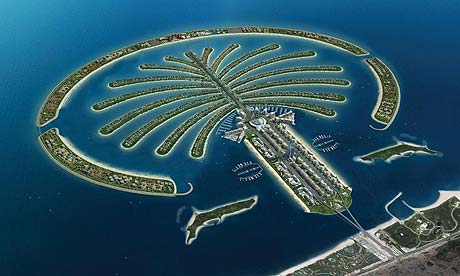
Some numbers from the Guardian:
13m: The number of liters of desalinated drinking water the Palm Jumeirah uses when at capacity (they didn't say in what period. It may in one day).
28: Bottlenose dolphins have been flown in from the Solomon Islands to populate Dolphin Bay, an 11-acre lagoon
94m: The cubic meters of sand used to build the Palm Jumeirah
84: The site has doubled the natural 42-mile coastline of Dubai
4: The Palm is four times the size of Hyde Park in central London
Tuesday, April 22, 2008
The Hype is Moving West-ward
A few years ago, it was not uncommon to see ads for Dubai real estate in the US, specifically the DC and New York newspapers (those being the two US cities in which I spend the most time). There were even quasi-fraudulent "get rich investing in Dubai real estate" weekend seminars held in hotel ballrooms. Now that the market has stabilized (and may even go down a bit as more buildings are finally completed and go online, the marketing fury has moved on. I initially assumed it had just died down a bit to more rational levels, but my recent extended stay in Moscow suggests otherwise. There, ads for Dubai real estate about, with even flashing neon billboards and banners hanging from high rises touting apartments (sometime it is villas, but mostly apartments) here in DXB.
The advertising has even gone a step further. I am currently considering purchasing an apartment in Moscow (I would have done so already, but spending 1,300,000 Euros for a one bedroom, even a nice one, seems a bit much, and there isn't a lot of real estate that isn't either over budget or poor quality, which means I'm still looking), and I am starting to get annoyed by the number of listings, officially in Moscow, that are really for units in Dubai. I guess the idea is that anyone with money to buy real estate in Moscow could be tempted to spend instead in Dubai. The tactic must work, as these listings are everywhere, enough so that real Moscow sellers stopped using them and I've basically given up on independent listings and am sticking to Moscow real estate agencies and their own vetted listings. It's a real pain though - Moscow agencies don't usually cross list, which means that I have to work with several agencies to see a good range of places.
Friday, March 7, 2008
The Unforeseen Hazards of Construction and Real Estate in Dubai
I have seen quite a few advertisements (including one flashing billboard) to buy real estate in Dubai during my stay in Moscow. Part of this I'm sure is just going farther afield efforts to prop up the real estate sales, but the fantastic promises made by advertisers here bring to mind some of the issues that are involved. I am also in the early stages of shopping for a new residence myself, which probably accounts for why these issues seem so fascinating and hazardous.
The first real issue for foreigners such as myself is the type of land. I am only interested in freehold, which means property which I can purchase and own, as opposed to leasehold, which is property that I own, but on land which I am only leasing from the government. This lease can be for 99 years, but it does increase restrictions on what I or any heirs can do with it. It was the introduction of widespread freehold property that really sparked the beginning of the property boom/bubble a few years back. That the offer of a residency visa (and the banking privileges that includes in the tax-free USE) with a purchased residence.
For starters, while a growing number of completed villas and apartments are available for sale throughout Dubai, many are still under construction. They tend to cost a little less than comparable ready-made residences, and there have been many cases where buyers could sell them at a great profit once they were ready, but there are also risks. I am only looking at completed housing, however, mostly because of the first two of the following concerns.
The first is the most obvious. An image which looks good in an artist's rendering may be put together with poor quality finishings, or not even look that way at all. I've seen ads showing grass and trees where there were none, and even ads which erase neighboring buildings, to give the building being sold the appearance of being in a more spacious area, or, in one case, on the waterfront where in reality and entire row of buildings stands before it (alas I misplaced the ad in question, but it was for a building in the Marina area and the ad is in the In-Flight magazine for Emirates, among other places). You buy now, and when you move in your wall could be cracked, the faucets super cheap and unattractive, the playground non-existent and the wide green lawn a small bricked over terrace. This is enough of an issue that there is an ad on the radio for one development using the promise that the completed development would match which was promised as their "hook."
New topography. One of the cooler things about construction in Dubai is the ability and willingness to change the topography to suit the building. The Palms are probably the most famous cases of this, but they are by far not the only ones. While the Marina was first being built, buildings that were on the water when first showed and sold later became a few rows away as the land was filled in. On the Jumeirah Palm apartments that had a canal view when sold now have a view of earth (a filled-in canal) which supports the elevated metro platform, and will one day be a view of the elevated metro itself. One person I know purchased their apartment across from the actual Marina because they were pretty sure that the Marina would be left alone and that his Gulf (and Palm) views would be preserved.
Financial risks. These aren't so terrible, but they exist. I do not mean that the prices of your purchase could go down; they could, and although a workers amnesty reduced the number of construction workers in Dubai, which reduced the number of construction sites that could run 24-hours cycles, or just extended-schedule cycles, which in turn slowed down how quickly they would all be on the market and increase supply, they will still be finished one day, which will increase supply, which will have an effect. The whole market could collapse entirely for that matter (I don't think it will, but it could).
The financial risk that I am talking about is the one borne when you put money down. This is of course a standard practice if you purchase an apartment or villa still under construction. I did the same when I bought an apartment in the US. The difference is that when I put my money down in the US it went to an escrow account, where neither I nor the developer could touch it. When the building was finished and we went to settlement, that money was added to the rest of my payment to pay the entire amount. In Dubai the developer gets the money immediately. They could save it, invest it conservatively, use it to fund the construction of your development or give it away for all the control you have. They tend to invest it. This became a problem a while back however, when one of Dubai's two major development firms gambled big and lost a lot a large portion of their assets on the Dubai stock market. The company could have gone under and everyone who made deposits would have been out of luck. The good part about an authoritarian government and (semi)managed economy, however, is that this was not allowed to happen; that company's leadership was ordered to save the company using their own considerable personal assets, which they did.
An ad for yet a tower in the marina area. The area looks like that, only the buildings are surrounded by many others, there is no water in the background, and the trees (clearly photoshopped in in the original photo) occupy area occupied by more buildings in real life.
Monday, February 25, 2008
Diaghilev Burns, the Moscow "Elitny" Scene and Property Raids
Moscow club burns itself down to avoid going out of style?
One of the more annoying features of life here in Moscow is the obsession with "elitny." A cognate of the English word "elite," and sometimes used to mean exclusive, it really means expensive. There are elitny apartments, elitny restaurants* and even a free HR and employment newsletter available at my gym, "Elitny Personnel." The reason this is so annoying is that Moscow doesn't have much "in the middle" - most of the city is either cheap, and not that nice, or "elitny," which means you have to buy into the whole "I am visibly and vocally better than everyone else" vibe. Which is a pain if you're me, who likes nice things, and even a flashy time sometimes, but lacks the patience, insecurity and (hopefully) pettiness that means it needs to be about being better than others more than just a good time with the people I came with. The whole vibe makes me feel guilty and is a real turn off. It also calls to mind one of my favorite sayings by former British Prime Minister* and chancellor of my undergraduate university Margaret Thatcher; "Being powerful is like being a lady. If you have to tell people you are, you aren't."The same applies to being elite, and while Moscow does have some of the truly elite, they aren't at most of these establishments, and most of the people aren't them.
The main focus of all this is a few night clubs, where a door policy called face control (really money control. People like to say it is wealth for men and beauty for women, but I’ve noticed that the former goes a lot farther than for both genders). It can be strict, or arbitrary, and groups of friends are sometimes broken up to increase the social pressure. The weird part is how pushy it can get; I’ve seen people bunch up at the door and push, so that there is a dense cluster at the entrance and empty space a few feet back. Everyone wants to be in front of the bouncer and is afraid to wait their turn.
Of course this isn’t a very line-friendly country anyway (trying to navigate the aisles at my Perekrestok grocery store during peak hours can be hazardous), but the tight ball of people/empty space pattern is fairly extreme, and a little silly. Back in the day (I think it was in 1999) I went to a Versace show in Milan where the Backstreet Boys performed. The entrance was swarmed with girls wanting to see their idols (one of which kissed the gay director’s cheeks to kiss the Backstreet Boy molecules which might still be there after he cheek-kissed them hello). Face control involves less people than that shriek-fest, but is more intense.
That said, I occasionally yield to the temptation and abandon my one-woman abstention from the elitny fuss. They are flashy, they are trashy, they are overpriced and they aren't elite, but they can be a lot of fun.
Which is why I was torn between Schadenfreude and dismay when Diaghilev burned down. Arguably the most famous of the elitny clubs, Diaghilev has been promoted by a thousand reviews and travel guides calling it "the most exclusive club in Moscow." This was not entirely true, but it was elitny, and it was one of the best clubs in the city. Named after Sergei Diaghilev (who really was elite), it was for a time the premier club of Moscow, or at least the hardest to get in. So hard, that when a Moscow Diskoschnitte actually risked denial and insulted the chief bouncer, a local expat paper wrote an article about it.
This started to change last summer; new competition combined with the natural life cycle of any "next big thing" meant that face control relaxed a little (although not so much, as to do that would immediately make all the people who still wanted to go there, stop). The holiday week following New Year's even brought an advertisement for Diaghilev's events in a banner over Tverskaya Street.
Which is why, when the club burned down (on a Thursday morning - three people were injured but no one waas killed), my first reaction was aggravation, as the Leading Man was visiting from the US and this meant that a lot of Diaghilev's customers would be at Rai, the club to which I planned to take him. Russia must be wearing off on me because my second thought was "whom does it benefit?" This is a Russian phrase used to work out the true machinations behind any government conspiracy and/or shady deal. There are a few explanations, all of which are completely crazy, but which shed interesting light into some of the craziness at work in this wild city.
The first theory was hinted at in the Associated Press story which, in a parting sentence, mentioned that "more recently a Moscow government-linked construction firm has been pushing to redevelop the building, which occupies valuable land." Real estate in Moscow's center is very hard to come by; 140 million people want to live there, but only 1.5 million do, and raids on companies lucky enough to occupy it are common. In the early nineteen nineties, when the city was even wilder and property rights less clear, this could take the form of an actual raid, with mafiosi thugs physically taking possession of a building and then arguing that it was theirs to being with. Now it is a bit more complex, and often business owners are charged with crimes, or forced out in some other way. This may be what happened to Diaghilev; someone wanted their property, but they weren't leaving.
Diaghilev was fairly high-profile though, making it that much harder to launch a raid, but add in an an unfortunate accident in the form of a fire, and then all of a sudden, it becomes a bit more possible. What is more, it occupied city land, and Mayor Luzhkov is expected to leave office soon after the upcoming presidential elections. He and his associated patronage networks including his wife - quite possibly Russia's wealthiest woman - and her multi-billion dollar business empire, much of it in Moscow real estate). Someone may be feeling the pressure to move now, while their own position and influence is more certain.
The story I prefer, if only because it is more dramatic, and, in a way, more principled, is that the people behind Diaghilev may have burned the place down itself. Ad I mentioned before, although still popular, its star was on the wane, and the management, aware of how much their status and that of all their establishments (they own several clubs and other businesses, both within Russia and without) hinges on the hyper-fickle wind of popular opinion and reputation, may have opted to burn out rather than fade away.
It could also be some combination; knowing that Diaghilev was doomed to fade eventually, the arsonist may have gambled that it was a bit safer to go after Diaghilev when the management wouldn’t mind quite as much, or the management could be sing the fire as part of the larger real estate scheme, this way preserving their reputation and eliminating some restrictions on building/renovating/tearing down yet another historical building.
Of course, it could really have been just a fire. My gym was a strip club previously, before a fire gutted it and it became my gym. It's a nice gym and the prices relatively steep, but such a moneymaker it isn't.
*Cafe Pushkin is perhaps the most famous, and is the subject of way too much hype, but it is exempt from the above complaints. I really like it, in spite of (and perhaps a little because of) all it's theme-iness. That the first floor is open 24 hours is the icing on the cake.
Sunday, February 24, 2008
Corporate Raids for Moscow Real Estate
A nice article from the Moscow Times providing an overview of the risks faced by businesses in possession of valuable real estate. One day I will write a full post on the reasons behind the insane real estate prices in parts of Moscow, but for now, here is a piece by someone else on one of the consequences.
Wednesday, February 13, 2008. Issue 3841. Page 2.
Corporate Raiders Use Cash, Friends
When the police came to search his office in central Moscow, Andrei was surprised but calm. He had nothing to hide, after all.
But that sunny spring morning two years ago turned into a nightmare. The policemen showed Andrei a transparent bag with a white sugar-like substance that they said was cocaine found in his office. They detained Andrei and shoved him into an isolation cell. He was not allowed to make any telephone calls to his family or to speak with a lawyer.
"I racked my brains for two days trying to understand what was going on and why someone wanted me in jail," Andrei said.
The mystery was cleared up when a smiling lawyer came to the cell on the second day and announced that he had a solution. He said the criminal case would be dropped if Andrei signed a contract transferring ownership of his office to a company that he represented.
"I couldn't believe what I was hearing. I had read about people losing their property this way, but I never thought that something like that could happen to me," Andrei said.
"I signed the contract, and they got my property. I had no choice," he said.
Andrei's business is among thousands that are taken over in illegal raids every year in and around Moscow. The number has soared in recent years, creating such a huge problem that the State Duma intends to consider legislation to fight the raiders this spring, Duma Deputy Speaker Oleg Morozov said last month.
In the West, corporate raids are run-of-the-mill affairs: A stronger company legally takes over a weaker one, and both sides usually benefit from the deal.
Not so in Russia. Raiders here use their links to corrupt officials to illegally seize businesses, often with the aim of acquiring prime real estate. The raiders often include former intelligence officers, policemen, lawyers and people with ties to well-placed state officials. On their payrolls are judges, prosecutors and bureaucrats on all levels. Through them, the raiders can order a search of a business, gather information about the owner, and falsify whatever documents they need to take over the business.
"Unfortunately, raiders are people who work for the system, and through it they can falsify anything they want," said Gennady Gudkov, former head of a working group that tracked the issue in the previous Duma.
There are no exact figures for how many raider attacks occur annually. Gudkov said his working group registered about 1,000 cases per year in Moscow and a similar number in the Moscow region. But these, he said, "were only the tip of the iceberg." The real figure is probably four to five times higher, he said. Media reports have put the countrywide figure at around 70,000.
Other than Moscow and the surrounding Moscow region, the favorite targets for raiders are in St. Petersburg and the Leningrad region. Real estate commands top prices in these areas, and competition is brutal for the few properties that are available for legal purchase.
Many businessmen, police officers and other officials interviewed for this report spoke on condition of anonymity, citing the sensitivity of the issue and fear of reprisal. The businessmen also asked that their former companies not be identified. They said they had not complained to police, prosecutors or the Federal Security Service because they believed the raiders had links to these agencies.
Konstantin, a Moscow businessman, said he learned in 2006 that he stood no chance against raiders. He said two tall men in their mid-30s entered his shop in central Moscow one day, looked around and announced that the location was perfect.
Konstantin told them that the shop -- his main source of income -- was not for sale. But the men laughed and said they did not intend to buy it. "You can make things easy and sign a sales contract. If you don't, we will get a signed contract anyway, but we'll have to hurt you and your family first," one of the men said, Konstantin recalled.
Days after the visit, tax and fire inspectors carried out separate checks of the shop. The taxmen accused Konstantin of evading taxes, and the fire inspectors said the electrical wiring was in such a state of disrepair that it had to be reinstalled completely.
Konstantin tried to stall the inspectors, hoping to find a way out of the dilemma. He said, however, that he gave up within weeks -- after he was beaten by unknown assailants, his wife was threatened and his daughter -- who never drank alcohol -- was detained on suspicion of drunk driving.
"I understood then that they really had powerful ties and that it was impossible to refuse their offer," Konstantin said.
He signed the sales contract, and the men got his shop. He said they even helped him to pack up and, in parting, asked him whether he knew of anyone who owned similar real estate.
How It Works
Raiders are split into two groups -- those who raid for their own gain and those who organize raids for money.
Those seeking their own gain scout locations on their own and work out a takeover plan. These raiders usually target small -- and easy to get -- businesses, like those of Andrei and Konstantin.
The hired raiders tend to work for big businesses and to target medium-size companies. The client tells the raider what kind of company or property he wants, and the raider estimates whether a takeover is feasible.
"Companies with a strong security service are difficult to get, and raiders prefer to ignore them," said a police officer who works for the Moscow force's anti-organized crime division.
He said many of these raiders are former officers from special units that were set up within the intelligence agencies in the early 1990s to keep an eye on new growing businesses. The officers' duties included checking whether the businesses acted within the law and did not sell sensitive technology abroad.
"They use their links and experience to make money," the police officer said.
The small-time raiders pay bribes out of their own pockets, while the hired raiders get their expenses covered by their employers. They charge a fee of about 20 percent of the value of the targeted business.
The police officer said a judge could be bought for $5,000 to $9,000, while it cost $5,000 to $70,000 to get someone arrested. Through their connections with intelligence officers, raiders are able to listen in on the telephone conversations of their targets at a cost of several thousand dollars per week.
The police officer said Andrei's arrest probably cost around $5,000, while $3,000 was more than enough to get his daughter detained.
In other words, the raiders paid no more than $50,000 to seize Andrei's and Konstantin's businesses but walked away with assets worth millions of dollars.
To get the assets of a medium-size company is relatively simple, according to the people interviewed for this report. Typically, raiders send a falsified protocol of an extraordinary shareholders meeting to the tax authorities, showing that the company has nominated a new general director. The new director signs a contract to sell a company asset -- usually the main building -- to a fictitious buyer, who in turn quickly resells the asset to someone else. If the real owner wants to prove his rights, he has to go through complicated bureaucratic procedures -- and even then he is unlikely to hang on to his business since it has been sold and resold so many times.
"All of this is impossible to achieve without the cooperation of people in high posts," said a former intelligence officer who is familiar with the issue.
In this scenario, the raid costs $200,000 to $250,000, and the new owner usually makes a profit of 1,000 times more. Companies unable to protect themselves might lose their property within two weeks.
A New Trend
The tactics for illegal acquisitions have evolved over the past 17 years, the former intelligence officer said.
"When someone opened a shop in the beginning of the '90s, bandits would visit him to offer protection in exchange for money," he said. Those who refused to pay lost their businesses.
"Now, these bandits have been replaced by the police and FSB," the officer said.
Also, big companies were the main targets of raiders in the early 1990s. Those companies now have organized themselves into powerful holdings or state corporations, putting them out of reach of even the most experienced raiders.
"Big companies have good juridical and security departments to protect them from those predators. They are difficult to get," Gudkov said.
So raiders instead have set their sights on small and medium-size businesses. An estimated 50 percent of all illegal takeovers involve shops and offices. The raiders are rarely interested in the businesses themselves but in the real estate where they are located. The properties can be rented for a high price or demolished to construct higher buildings.
"It is impossible these days to hang on to a property in Moscow if you don't have really good protection. And by that I mean people from the police and the FSB. I'm not talking about ordinary guys, but people who have good links," the police officer said.
As a result, small and medium-size businesses are bringing in former intelligence officers, policemen and bureaucrats with good links as co-owners.
Sergei said he spent several years worrying that someone would notice his flourishing factory, located 10 kilometers outside Moscow's city limits, and take it away. His worries lessened three years ago, when he made a well-connected intelligence officer a co-owner.
"If you don't have someone protecting you these days, anyone can take what you have. And as you are running like an idiot from court to court to prove that you are the owner of your property, they will sell and resell it so many times that you'll never get it back," Sergei said.
The intelligence officer got 30 percent of Sergei's business and, in addition to offering security, he deals with fire and tax inspectors and local bureaucrats. Besides intelligence officers, businessmen take police officials and local bureaucrats as co-owners.
"You really need people who can fire back if you want to keep your business away from the raiders," the former intelligence officer said.
Sergei said he was not aware of any small or medium-size businessman in Moscow or the Moscow region who had been able to hold onto his property without protection.
"If in the '90s the bandits protected us," he said. "Now I see former bandits giving shares of their now-legalized businesses to police officers or intelligence officers to protect themselves from the raiders."
Subscribe to:
Posts (Atom)